

Hercolyn D


Description Hercolyn D
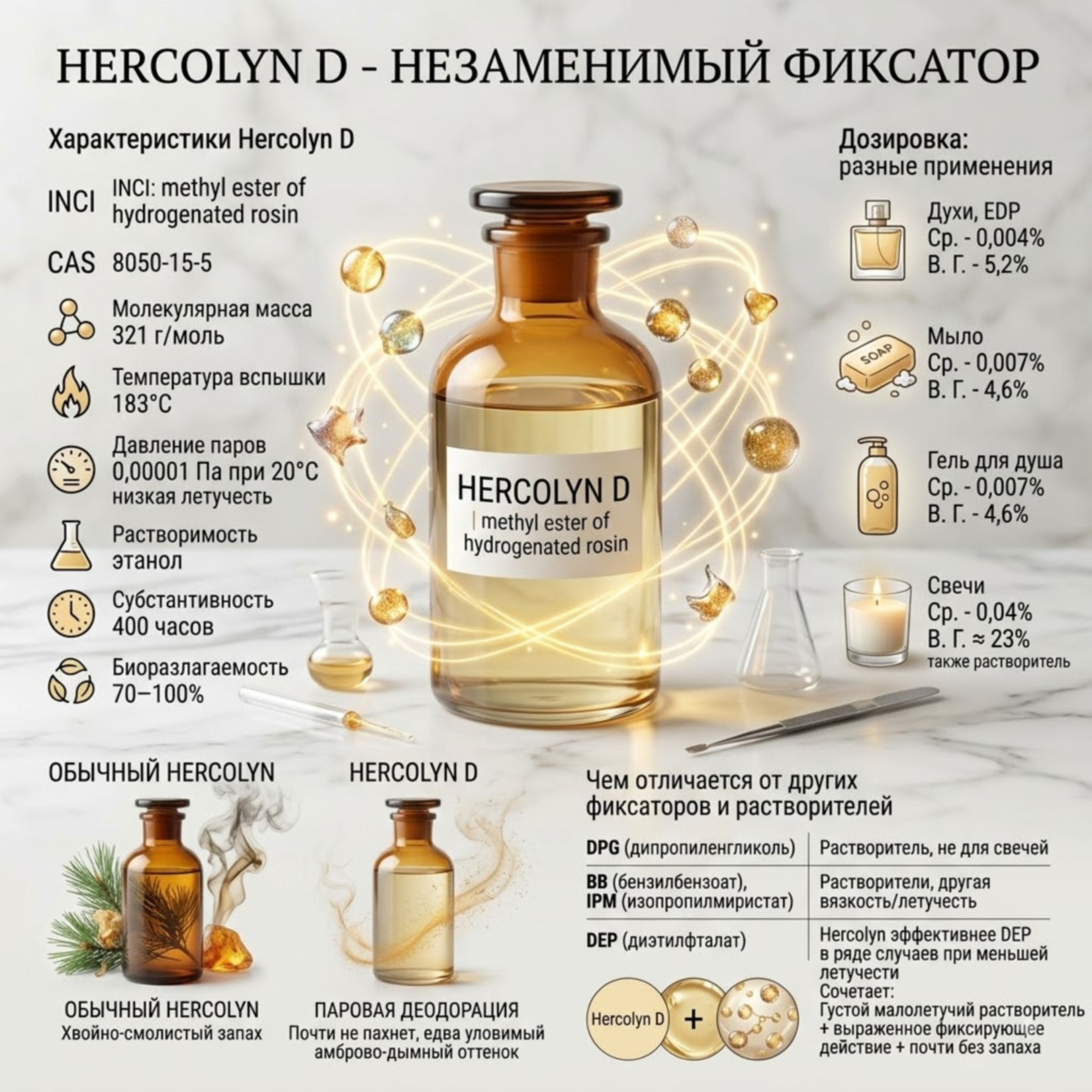
Hercolyn D - an indispensable fixative
Hercolyn D is virtually odourless: it has a barely perceptible amber-smoky undertone that does not alter the fragrance profile. If you are looking for an ingredient that will add a resinous or amber note, this is not the right choice. The character of the fragrance is determined by the other ingredients in the formulation, whilst Hercolyn D stabilises and prolongs their effect.
Technical specifications of Hercolyn D
- INCI - methyl ester of hydrogenated canphol;
- CAS - 8050-15-5;
- Molecular weight - 321 g/mol;
- Flash point - 183 °C;
- Vapour pressure – 0.00001 Pa at 20 °C;
- Solubility - in ethanol;
- Stability - 400 hours;
- Biodegradability - 70-100 per cent.
Hercolyn D differs from standard Hercolyn
The difference lies not only in its appearance. Hercolyn D undergoes steam deodorisation, which is not the case with standard Hercolyn. Undesodorised Hercolyn has a noticeable coniferous-resinous odour: in delicate floral compositions, its excessive use shifts the fragrance towards woody-coniferous notes. The deodorisation of Hercolyn D reduces this risk, but does not eliminate the need to control the dosage in delicate formulations.
Dosage: varies for perfumes, soaps and candles
General guidance for perfume concentrate is up to 20 per cent (this figure is quoted by all specialist suppliers). However, this figure refers to the concentrate before dilution, not to the finished product. For the finished product, the ranges vary considerably - the manufacturer’s (DSM-Firmenich) data specifically for the finished product are given below:
- Luxury fragrances (perfume, EDP): on average - 0.004 per cent, upper limit - 5.2 per cent
- Soap: on average - 0.007 per cent, upper limit - 4.6 per cent
- Shower gel: on average - 0.007 per cent, upper limit - 4.6 per cent
- Candles: average - 0.04 per cent, upper limit - 23 per cent
For candles, the upper limit is an order of magnitude higher - in this case, Hercolyn D acts not only as a fixative but also as a solvent for the fragrance in the wax, which is why a significantly larger quantity is added.
Solubility and physical properties
Appearance: a very viscous, stringy liquфid, varying in colour from straw-coloured to pale amber. Soluble in ethanol – suitable for both alcohol-based perfumes and non-alcoholic oil-based compositions (popular on the Arab market). Flash point - 183 °C, vapour pressure - 0.00001 Pa at 20 °C: its low volatility ensures a stable fixing effect.
How does it differ from other fixatives and solvents
The same question (‘how does this differ from other fixatives, and what should one look out for when choosing?’) regularly arises among customers - and, as a rule, remains without a substantive answer. The difference lies in their intended use:
- DPG (dipropylene glycol) is a solvent for alcohol- and water-based fragrance compositions, but not for candles: it does not mix with wax, so the fragrance ‘migrates’ to the surface rather than being distributed evenly.
- BB (benzyl benzoate) and IPM (isopropyl myristate) are also solvents for candle fragrances, but with different viscosities and volatilities; they are usually chosen for other purposes within the formulation, rather than as the primary fixative.
- DEP (diethyl phthalate) - according to industry sources, Hercolyn acts as a fixative more effectively than DEP in a number of cases, whilst possessing significantly lower volatility (this is a historical assessment, not an absolute rule for every formulation).
- Hercolyn D combines both roles: it is a thick, low-volatility solvent with a pronounced fixing effect and virtually no odour of its own.
Reviews about Hercolyn D from real customers
No reviews found